
How to Troubleshoot a Furnace That Won’t Turn On
It is a scene that every homeowner in Ten Mile dreads. You wake up to a freezing house, much colder than it should be. You check the thermostat and see that the temperature inside has dropped well below the programmed setting. The furnace, the powerful machine you rely on to keep your family warm and safe through the Tennessee winter, is silent. That silence is often followed by a wave of anxiety, with visions of expensive, catastrophic repairs. While a furnace that will not turn on is certainly a serious problem, it is not always a sign of a major failure. In many cases, the root cause is surprisingly simple, something that can be identified and even corrected by a homeowner in just a few minutes, without any special tools. Before you make a call for emergency service, taking a few moments to run through a logical troubleshooting process can save you time, money, and a great deal of worry.
Start with the Simplest Fix: The Thermostat
The thermostat is the brain of your entire HVAC system. It is the command center that tells your furnace when to turn on and when to turn off. If it is not communicating correctly, the furnace will not run, even if the furnace itself is in perfect working order. This is the first place you should always check, as the solution is often found here.
First, check the most basic setting: is the thermostat set to “HEAT”? This may sound obvious, but it is the single most common reason for a “broken” furnace. During the mild swing seasons, it is easy to forget the system was last set to “COOL” or “OFF”. If the setting is correct, look at the temperature set point. The furnace will only engage if the target temperature is set higher than the current room temperature. If you have the thermostat set to 68 degrees and the room is already 68 degrees, the furnace has no reason to turn on. Try raising the temperature setting five degrees higher than the current room temperature and wait a minute. This should be enough to send a clear signal to the furnace to start its heating cycle.

If the settings appear correct, the next item to check is the power source. Many modern digital thermostats are not hard-wired for power and rely entirely on batteries. If these batteries are dead or dying, the thermostat’s screen may be blank or flashing, and it will be completely unable to send the signal to the furnace. Most thermostats have a small panel that pops off or slides open to reveal AA or AAA batteries. Replacing them with a fresh set can often bring your entire system back to life instantly.
Finally, consider the thermostat’s programming. If you have a programmable or smart thermostat, its schedule may be overriding your manual setting. It could be in a pre-set “Away” or “Vacation” mode that is programmed for energy savings. Review the schedule to ensure it is not in an “unoccupied” time period. You can typically use a “Hold” or “Override” function to bypass the schedule and force the system to heat to your desired temperature. If these thermostat checks do not solve the problem, it is time to move on to the furnace unit itself.
Check the System’s Power Sources
A furnace requires power to operate, and for most systems in our area, this means two sources: electricity and a fuel, like natural gas or propane. A disruption in either of these will stop the furnace cold. The electrical power is often the source of a simple, overlooked issue.
Every furnace is connected to your home’s main electrical panel through a dedicated circuit breaker. This breaker acts as a safety switch, and it can “trip” if there is a power surge or if the system’s motor pulls too much current. Go to your breaker box and find the one labeled “Furnace,” “HVAC,” or “Air Handler.” If the switch is in the “OFF” position or in a middle position, it has tripped. To reset it, you must push it firmly to the full “OFF” position and then flip it back to “ON.”
Furnace stopped turning on? Click here for our emergency HVAC service.
In addition to the circuit breaker, there is a second, more visible electrical switch dedicated to the furnace. This is a safety and service shut-off switch, and it often looks just like a standard light switch. It is usually located on the side of the furnace itself or on a nearby wall. This switch is installed so that a technician can safely cut power to the unit while working on it. It is very easy for this switch to be bumped accidentally or mistaken for a light switch and turned off. Ensure this switch is in the “ON” position.
One more power-related safety feature exists inside the furnace itself. The furnace has a blower compartment door, which is the panel you remove to access the air filter. This door is almost always equipped with a safety switch, similar to the one in a refrigerator door. If this panel is not fully seated and closed, the switch is not depressed, and the furnace will not receive power. This is a common issue right after a homeowner has changed the air filter. Double-check that the service panel is closed securely and that any retaining screws or latches are in place.
The Critical Role of the Air Filter
That simple, replaceable air filter has a surprisingly critical job. While its primary role is to protect your indoor air quality, its secondary role is to protect the furnace from itself. A furnace needs to “breathe.” It is designed to pull in a massive, continuous volume of air from your home, heat it, and push it back out. A dirty, clogged air filter strangles the system, starving it of that essential airflow.
When the furnace cannot get enough air, the heat it generates has nowhere to go. This causes the internal components, specifically the heat exchanger, to overheat to dangerous levels. To prevent a fire or a catastrophic failure, your furnace is equipped with a safety sensor called a high-limit switch. When this switch detects an unsafe temperature, it does its job: it shuts down the entire furnace immediately.

In many cases, the furnace may try to start, run for a few minutes, overheat, and shut down. It may repeat this cycle a few times before “locking out” for safety, at which point it will not turn on at all. This is often the root cause of a “furnace that won’t stay on.”
Go to your furnace and check the air filter. If it is visibly gray, matted with dust, or you cannot see light through it, it is long overdue for a change. Replace it with a new, clean filter of the correct size. After you replace the filter, the furnace may not start up immediately. You will often need to reset the system’s safety lockout by cutting its power. You can do this by turning off the furnace service switch or flipping the circuit breaker. Wait one minute, then turn the power back on. This resets the control board and allows the system to try a new heating cycle, this time with the proper airflow it needs.
Fuel Supply and Ignition Issues
If the thermostat and power sources seem correct, and the filter is clean, the problem may lie with the fuel supply or the ignition system. This is where troubleshooting becomes more serious, and safety must be your top priority.
If you have a gas furnace, you must confirm that it is receiving gas. Near the furnace, there will be a gas line with a manual shut-off valve, usually with a red or yellow handle. This valve is “open” when the handle is parallel to the gas pipe and “closed” when it is perpendicular. Make sure this valve is in the open, parallel position.
Want to learn more about HVAC replacement? Click here for more information.
If the valve is open and the furnace still will not light, check your other gas appliances. Does your gas stove light? Does your gas water heater have hot water? If your other appliances are also not working, the problem is not with your furnace. You may have an issue with the gas meter, or if you use propane, your tank may be empty. In this case, you will need to contact your utility provider.
If your other gas appliances work, the problem is isolated to the furnace. Modern furnaces do not have an old-fashioned pilot light that stays on all the time. They use an electronic ignition system, which is either a hot surface ignitor (which glows bright orange) or an intermittent pilot. These components are highly effective but they do wear out and fail. The furnace’s control board will try to light the burners, and when it fails after a few attempts, it will shut the system down for safety. This is not a problem a homeowner can or should fix.
If you have a much older furnace with a standing pilot light, you can visually check to see if it is lit. If it is out, there are usually instructions printed on a label inside the furnace panel for relighting it. However, if you are not completely comfortable with this process or if you smell gas, do not proceed.
When to Stop and Call a Professional
The troubleshooting steps involving the thermostat, circuit breakers, and air filter are safe for any homeowner. Once you move beyond these basics, you begin dealing with high-voltage electrical components, combustible fuel, and complex control boards. Attempting a DIY repair in this territory is not only dangerous but can also lead to much more expensive damage.
There are several clear signs that you have reached the end of the line for DIY troubleshooting and it is time to call a professional. The most urgent sign is the smell of gas. If you smell natural gas or propane, do not attempt to light the furnace, do not turn any lights on or off, and do not use your phone inside the house. Leave the home immediately and call your gas utility company or 911 from a safe distance. After they have declared the area safe, you will need to call an HVAC technician to find and repair the leak.
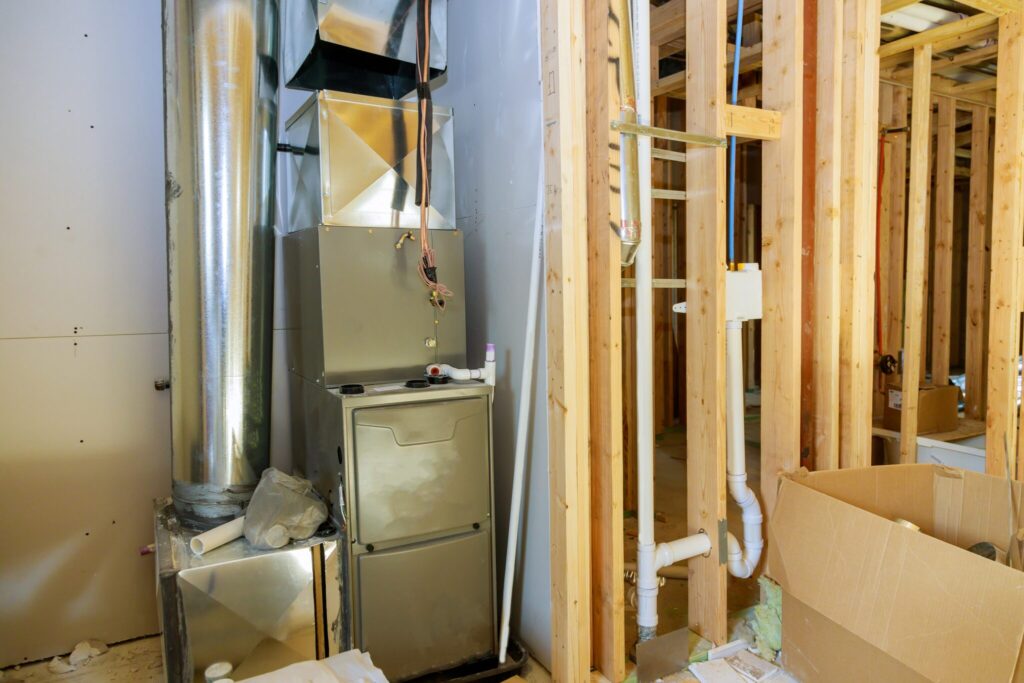
Other clear stop signs include any loud, mechanical noises like grinding, squealing, or banging. These indicate a serious mechanical failure, such as a broken blower motor or fan. Immediately turn the system off at the breaker to prevent further damage. If your circuit breaker trips immediately after you reset it, you likely have an electrical short, which is a significant fire hazard. Do not attempt to reset it again.
Finally, if your furnace tries to start, you hear a “whoosh” as the burners ignite, but then it shuts off after only a few seconds, you likely have a faulty flame sensor. This is a common part to fail, but replacing it, while simple for a technician, involves working inside the burner compartment. If you have checked the thermostat, power, and filter, and the furnace still will not work, the problem is internal.
A furnace that fails on a cold day is one of the most stressful experiences a homeowner can face. It is a disruption to your comfort, a worry for your family’s safety, and a potential financial burden. However, that initial panic can often be resolved by a calm, logical check of the simplest things. By confirming your thermostat settings, checking for dead batteries, ensuring the circuit breakers and power switches are on, and replacing a clogged air filter, you can solve a large numberat of common furnace problems yourself.
These simple steps can save you the cost and inconvenience of a service call. But they also serve another purpose: they help you know when you are facing a problem that requires professional expertise. When you have exhausted these safe, simple checks and your heat is still off, you know the problem is with the complex components of the furnace itself. At that point, do not risk your safety or your equipment. It is time to call the professionals at Affordable AC & Service. Our trained technicians have the tools and experience to diagnose the problem safely and get your heat restored quickly, ensuring your Ten Mile home is warm and comfortable once again.