
How to Seal Your Home for Lower Heating Bills
Sealing your home before the cold settles into East Tennessee is one of the cheapest ways to cut your heating bills, and most homeowners can knock out a large share of the work in a single weekend with a caulk gun, a few cans of spray foam, and a roll of weatherstripping. Air leakage accounts for a significant portion of the energy used to heat the average home, because every cubic foot of warm air that escapes through a gap in your building envelope has to be replaced by cold outdoor air that your furnace or heat pump then has to heat all over again. September is the right time to handle this work, since daytime temperatures in Ten Mile, Kingston, and Spring City are still mild enough to work comfortably outdoors while the caulk and foam cure properly before the first hard freeze arrives. Sealing also reduces the run time on your heating system, which lowers wear on the blower motor, the compressor, and the ignition components, extending the useful life of equipment you have already paid for. Many homeowners who seal their homes thoroughly report noticeable improvements in comfort within days, particularly in rooms that always felt drafty or never quite reached the temperature the thermostat promised. The catch is that sealing has to be done in the right order and in the right places, because chasing the wrong leaks wastes an entire afternoon on gaps that were never costing you much money in the first place. This guide walks through where the leaks actually are, how to seal them correctly, and when the job crosses the line into work that needs a licensed HVAC contractor.
Where Air Leaks Cost You the Most on Heating Bills
The largest air leaks in a typical home are almost never the ones you feel with your hand, and that single fact trips up most do-it-yourself sealing projects. Warm air rises, so the biggest losses happen at the top of the house through attic penetrations, recessed light housings, plumbing chases, and the gap where the chimney passes through the ceiling plane. As that warm air escapes upward, it creates negative pressure at the bottom of the house, which pulls cold air in through the crawlspace, the rim joist, and any gap in the foundation wall. This is called the stack effect, and it turns your home into a slow-moving chimney every time outdoor temperatures drop below indoor temperatures. Sealing the top and bottom of the building envelope first breaks that cycle and delivers far more savings per dollar than sealing the windows and doors everyone notices. Windows and doors still matter, but they usually represent a smaller slice of total leakage than homeowners assume. Working from the attic down and the crawlspace up gives you the best return on both your time and your materials.
The Attic Air Sealing Checklist for Lower Heating Bills
Start in the attic, because the ceiling plane is where the majority of your expensive heated air exits the house. Pull back the insulation around any penetration you find and look for the telltale signs of air movement, which include dirty insulation, dark staining on the framing, and frost patterns in cold weather. Plumbing vent stacks, electrical wire penetrations, and HVAC boot connections almost always have gaps around them that were never sealed during construction, and each one of those gaps is an open pathway from your conditioned space into a vented attic that sits close to outdoor temperature all winter. Use fire-rated caulk or canned spray foam for gaps up to about three inches wide, and cut rigid foam board to fit larger openings before sealing the perimeter with foam. Top plates on interior walls deserve particular attention, since the gap between the drywall and the framing runs the entire length of every wall in the house and adds up to a surprising amount of open area. Do not seal around the chimney or any B-vent flue with foam or standard caulk, because those surfaces get hot enough to create a fire hazard and require sheet metal flashing with high-temperature sealant instead.
Recessed can lights are one of the worst offenders in older East Tennessee homes, and they need to be handled with care. Older non-IC-rated housings are designed to breathe, which means they were built to leak air on purpose so the fixture does not overheat, and burying them under insulation or sealing them tight creates a genuine fire risk. The correct fix is to build an airtight box around the housing from rigid foam or drywall, maintaining the required clearance, and seal the box to the ceiling drywall. A better long-term answer is replacing the old housings with modern airtight LED units that are rated for direct insulation contact, which removes the problem entirely and cuts your lighting energy use at the same time. Attic access hatches and pull-down stairs leak badly as well, since they are essentially uninsulated doors into a cold space, and adding weatherstripping around the frame plus a rigid foam cover on the attic side takes less than an hour. Every one of these fixes is permanent, and none of them requires you to touch the heating system itself.
Once the penetrations are sealed, check your insulation depth before you close the attic back up. Most homes in Meigs, Roane, and Rhea counties should have somewhere between fourteen and eighteen inches of blown insulation on the attic floor, and a great many older homes have half that or less. Insulation and air sealing work together rather than substituting for one another; insulation slows heat transfer through solid materials, while air sealing stops the bulk movement of heated air, and skipping either one undercuts the other. If your insulation is compressed, water-stained, or sitting well below the tops of the ceiling joists, adding more after you finish sealing gives you a substantial improvement in comfort during cold snaps. Make sure soffit vents stay clear by installing baffles at the eaves, because blocking attic ventilation traps moisture and leads to mold and rotted sheathing. If you find your ductwork running through the attic, note its condition while you are up there, since leaking ducts in an unconditioned attic waste heated air before it ever reaches a single room. Need help with leaking or dirty ductwork? Click here for our air duct cleaning service.
Sealing the Crawlspace and Rim Joist to Reduce Heating Bills
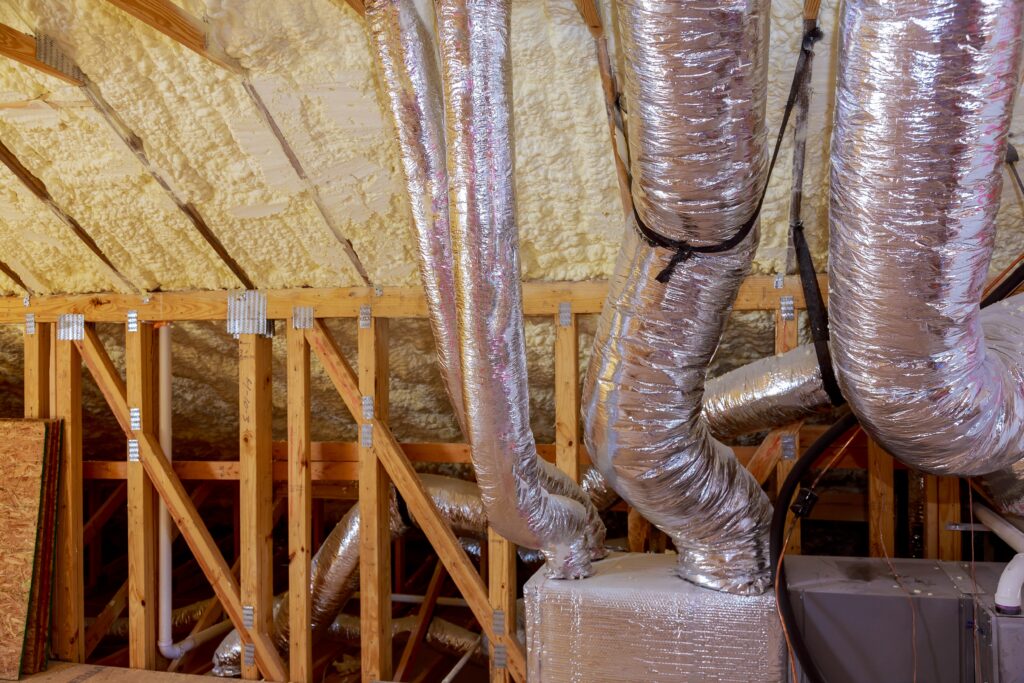
The crawlspace is the other half of the stack effect, and it is where most of the cold air entering your home originates. The rim joist, which is the band of framing lumber that sits on top of the foundation wall and supports the floor system, is the single leakiest assembly in most homes built before modern energy codes. Each joist bay creates an open cavity where the subfloor, the rim board, and the sill plate meet, and those seams were rarely sealed during construction. Cutting rigid foam board to fit each bay and sealing the edges with spray foam gives you both an air barrier and an insulation layer in one step, which is why this approach has become standard practice. Two inches of foam board in each bay makes a measurable difference in floor temperature in the rooms directly above, and homeowners frequently notice that difference the first cold morning after the work is done. Wear a respirator, eye protection, and long sleeves, because crawlspaces are dusty and the fiberglass and foam dust gets everywhere.
Beyond the rim joist, look at the crawlspace vents, the access door, and any penetration through the foundation wall. Older building practice called for open foundation vents year-round, but current practice in humid climates like ours favors sealing and conditioning the crawlspace, since outdoor air in a Tennessee summer carries more moisture into the space than it removes. If your crawlspace has a bare dirt floor, laying down a six-mil polyethylene vapor barrier and sealing the seams cuts ground moisture dramatically, which protects your floor framing and reduces the humidity load your HVAC system has to manage. Seal the gaps around plumbing lines, electrical conduit, and the refrigerant line set where it passes through the wall, since each of those creates a direct path for cold air and pests. The crawlspace access door should have weatherstripping and a latch that pulls it tight against the frame. Insulating exposed hot water lines while you are down there reduces standby heat loss and shortens the wait for hot water at the tap.
Do not overlook the ductwork if your system runs through the crawlspace, which is common in this part of the state. Flex duct that has come loose from a boot or a plenum connection dumps heated air directly into an unconditioned space, and that leak costs far more than any window gap in the house. Check every connection point for loose straps, torn insulation jacketing, and disconnected sections lying on the ground. Duct connections should be sealed with mastic or foil-backed tape rated for the purpose, not standard cloth duct tape, which dries out and falls off within a few years. Crushed or kinked flex duct restricts airflow enough to trigger high limit switches on a furnace or cause a heat pump to underperform, so straighten and support any section that is sagging between joists. If you find substantial duct problems, that repair typically pays for itself faster than nearly any other efficiency improvement available to a homeowner.
Windows, Doors, and Attached Garage Sealing That Lowers Heating Bills
Windows and doors get the most attention because they are the leaks you can feel, and they still deserve attention even though they are usually not the largest losses. Start with the door thresholds and sweeps, since a worn sweep leaves a visible gap at the bottom of an exterior door that acts as a direct inlet for cold air pulled in by the stack effect. Adjustable thresholds can be raised with a screwdriver until the door seals against the sweep without binding. Replace compressed or cracked weatherstripping around the jambs with new closed-cell foam or bulb-style stripping, and check the seal by closing the door on a dollar bill; if the bill slides out freely, the seal needs adjustment. Storm doors add another layer of dead air space and cut infiltration noticeably on doors that face prevailing winter winds from the northwest.
For windows, the leaks usually appear at the trim rather than the sash. Remove the interior casing on one window and you will often find the rough opening stuffed loosely with fiberglass batt, which stops almost no air movement at all. Replacing that batt with low-expansion window and door foam seals the gap properly without bowing the jamb, and reinstalling the trim over it takes only a few minutes. On the exterior, caulk the joint where the window flange or brick mold meets the siding using a quality exterior-rated sealant. Double-hung windows that rattle in the frame can be tightened with new sash locks, which pull the meeting rails together and close the gap between them. Clear plastic film kits are a legitimate temporary measure for single-pane windows in an older home, and they cost very little for the improvement they deliver over one heating season.
The wall between an attached garage and the living space is a frequently missed weak point that affects both energy use and indoor air quality. Garages are unconditioned, and they hold vehicle exhaust, stored fuel, paint, and lawn chemicals, so any air leaking from the garage into the house carries those contaminants with it. Seal the man door between the garage and the house with the same care you would give an exterior door, including weatherstripping and a proper sweep. Check for gaps around any ductwork, plumbing, or wiring that penetrates the shared wall or ceiling, and seal them with fire-rated caulk or foam. If you have a bonus room built above the garage, that room almost always runs cold in winter because the floor system is exposed to garage temperatures on the underside, and sealing plus insulating that floor cavity is usually the fix. Sealing this boundary tightens the envelope and keeps the air inside your home cleaner at the same time.
How Air Sealing Works With Your Heating System to Cut Heating Bills
Sealing your home changes how your heating equipment behaves, and understanding that relationship helps you get the full benefit without creating new problems. A tighter house has a smaller heating load, which means your furnace or heat pump runs for shorter periods and cycles less often to hold the same indoor temperature. Shorter run times translate directly into lower fuel or electricity consumption, and they also mean less wear on igniters, blower motors, contactors, and compressors. Tighter homes hold temperature more evenly as well, so the rooms farthest from the equipment stop swinging several degrees between cycles. There is a real limit to how far this goes without mechanical ventilation, since a house sealed extremely tight needs a controlled fresh air supply to manage indoor humidity and pollutants. Most existing homes in our service area are nowhere near that threshold, so aggressive sealing improves both comfort and air quality rather than harming it. The key is pairing your sealing work with a properly maintained system so the equipment can take advantage of the reduced load.
Why Heating System Maintenance Multiplies Your Air Sealing Savings
A sealed home paired with a neglected heating system leaves a large portion of your potential savings on the table. Dirty blower wheels, clogged filters, and fouled heat exchangers all reduce the amount of heat your system delivers per unit of fuel or electricity consumed, and no amount of caulk compensates for that. A furnace with a restricted return sees elevated temperature rise across the heat exchanger, which shortens component life and can trip the high limit switch, causing the burners to short cycle. A heat pump with a dirty outdoor coil loses capacity precisely when outdoor temperatures drop and you need capacity the most, forcing the auxiliary electric heat strips to run far more often than they should. Those heat strips are the single most expensive way to heat a home in Tennessee, and reducing their run time is where a large share of winter savings actually comes from. Annual maintenance addresses all of these issues before the heating season starts.
Professional maintenance also catches the safety issues that homeowners have no practical way to check themselves. A technician performs combustion analysis on a gas furnace, measuring carbon monoxide levels and verifying that the heat exchanger has no cracks that would allow flue gases into the supply airstream. This matters more in a tightly sealed home, because reduced infiltration means combustion byproducts have fewer paths to dilute and exit. Technicians also check draft on atmospherically vented appliances, verify that the flue is drawing properly, and confirm that gas pressure is set to manufacturer specification. Electrical connections get tightened, capacitors get tested against their rated microfarad values, and refrigerant charge gets verified on heat pump systems. Any of these findings, caught in September, is a scheduled repair rather than an emergency call on the coldest night of the year.
Timing your maintenance right after your sealing work makes practical sense for another reason. Sealing changes the pressure characteristics of your home, and a technician evaluating the system afterward sees the house as it will actually operate all winter. Static pressure readings, temperature rise, and airflow measurements taken under real conditions give a more accurate picture of how your equipment is performing than readings taken before the envelope changed. If your sealing work revealed duct problems in the attic or crawlspace, the same visit can address those repairs. Systems that were marginally oversized before sealing become more noticeably oversized afterward, which shows up as short cycling and uneven temperatures, and a technician can adjust fan speeds and staging to compensate. Ready to get your system checked before the cold arrives? Click here for our furnace maintenance service.

How Sealing Affects Heat Pump Performance and Winter Heating Bills
Heat pumps are extremely common across Loudon, Lenoir City, Farragut, and the surrounding communities, and air sealing affects them differently than it affects a gas furnace. A heat pump moves heat rather than creating it, and its capacity falls as outdoor temperature drops, which means there is a balance point below which the unit alone cannot keep up with the home’s heat loss. Reducing the heat loss through air sealing lowers that balance point, so the heat pump handles the load on its own down to colder outdoor temperatures than it could before. Every degree you push that balance point down is a degree at which your expensive supplemental electric heat stays off. On a January morning in the twenties, that difference shows up clearly on the power bill. This is the mechanism behind most of the winter savings homeowners see after a thorough sealing project.
Sealing also reduces the frequency and severity of comfort complaints that get blamed on the heat pump itself. Heat pumps deliver supply air at a lower temperature than a gas furnace, typically in the range of ninety to one hundred five degrees, which feels cool against skin even though it is warming the room. In a leaky house, cold drafts across the floor combine with that cooler supply air to make the system feel inadequate even when it is working correctly. Stopping the drafts removes half of that equation, and many homeowners stop reaching for the emergency heat setting once the house is sealed. Running emergency heat unnecessarily is one of the fastest ways to run up a winter power bill, since it bypasses the compressor entirely and heats the home with resistance elements. Understanding this distinction saves real money over a full season.
Defrost cycles are worth understanding too, since they alarm homeowners who have never had them explained. When outdoor temperatures fall into the thirties with moisture in the air, frost accumulates on the outdoor coil and the system periodically reverses to melt it off, producing steam from the outdoor unit and a brief blast of cooler air indoors. This is normal operation, not a malfunction, and a sealed home rides through those short cycles with less temperature drop because it loses heat more slowly. Excessive defrost cycling, however, points to a real problem such as low refrigerant charge, a failed defrost board, or a restricted coil. Ice building up on the outdoor unit and refusing to clear is a service call, not something to wait out. Is your heat pump not keeping up this season? Click here for our heat pump repair service.
Knowing When Air Sealing Reveals a Heating System Problem
Sometimes a sealing project uncovers evidence that the heating system itself needs attention, and recognizing those signs early prevents a small problem from becoming a failure. Rust or corrosion streaks on the furnace cabinet, water pooling near the base of the unit, or a strong odor when the burners fire all warrant a professional evaluation. Soot deposits around the burner compartment or on the vent connector indicate incomplete combustion, which is both an efficiency problem and a safety concern. A furnace that ran fine last winter can develop problems over the offseason as components sit idle and moisture works on metal parts. Discovering these issues in early fall gives you time to schedule a repair on your terms rather than during a cold snap when demand for service peaks.
Duct problems found during sealing frequently explain comfort complaints that seemed unrelated. Rooms that never heat properly are often served by a duct run that came loose, got crushed, or was never sized correctly for the load in that room. Return air restrictions cause similar symptoms, and a system starved for return air runs hotter, moves less air, and costs more to operate. Closed supply registers in unused rooms actually make this worse rather than saving money, because the system was designed to move a specific volume of air and blocking part of it raises static pressure throughout. If you find yourself closing vents to force air into cold rooms, the underlying issue is a distribution problem that needs to be measured and corrected. A technician with a manometer can identify exactly where the restriction sits.
Age and repair history should factor into how you interpret what you find. A system past fifteen years of service that needs a significant repair sits at a genuine decision point, since the cost of that repair applies toward equipment that may not last many more seasons. Newer systems have meaningfully better efficiency ratings and better low-temperature performance in the case of heat pumps, and a sealed home allows a properly sized replacement rather than the oversized unit that was probably installed originally. Right-sizing matters, because an oversized system short cycles, fails to dehumidify well in shoulder seasons, and wears out faster. A load calculation performed after sealing gives you accurate numbers to work from. That combination of a tight envelope and correctly sized equipment produces the lowest operating cost available.
Why You Need Professional Help to Get the Most From Home Sealing
Homeowner sealing work delivers real savings, and the projects described above are well within reach for anyone comfortable with basic tools. The limits show up where the building envelope meets the mechanical system, since duct sealing, combustion safety, refrigerant charge, and airflow measurement all require instruments and training that homeowners do not typically have. Getting those pieces right is what separates a modest improvement from a substantial one. A contractor who understands both the envelope and the equipment can tell you which remaining leaks are worth chasing and which are not. That guidance keeps you from spending a weekend on work that returns almost nothing.
Professional Duct Sealing and Testing for Lower Heating Bills
Duct leakage in an unconditioned attic or crawlspace is often the largest single energy loss in a home, and it is invisible without testing. Supply leaks push heated air into spaces you are not trying to heat, while return leaks pull cold air into the system and force the equipment to work against itself. A duct blaster test quantifies exactly how much air your duct system is losing and identifies where the losses are concentrated. Sealing those leaks with mastic at the joints, boots, and plenum connections produces immediate and measurable improvement. This is work that pays back quickly and lasts for decades when done correctly.
Boot connections at the floor and ceiling registers deserve particular attention, since the gap between the metal boot and the finished surface is rarely sealed during construction. Each of those gaps connects your conditioned space directly to the attic or crawlspace. Sealing them from inside the room with caulk helps, but the durable fix is mastic applied at the connection from the unconditioned side. Plenum and takeoff connections are another common failure point, especially in systems where the original installer relied on cloth tape. Proper mastic never dries out, never falls off, and remains flexible through years of thermal cycling.
Insulation on ductwork matters as much as sealing does when the runs pass through unconditioned space. Duct insulation that has torn, slipped, or become saturated allows heat to conduct straight out of the supply air before it reaches the register. Replacing damaged jacketing restores the temperature of the air arriving at the room. In some cases, relocating ductwork into conditioned space during a system replacement is the better long-term answer. Want to know more about improving airflow through your ducts? Click here for our air duct cleaning service.
Pre-Season Heating Service That Protects Your Sealing Investment
Scheduling heating service in September rather than December gives you scheduling flexibility and avoids peak-season wait times. Technicians have open availability in the shoulder season, and any parts needed for a repair can be ordered without leaving you without heat. A system that gets inspected before the first cold night is far less likely to fail during one. Preventive service also preserves manufacturer warranty coverage on many systems, since documented annual maintenance is a common requirement. The cost of a maintenance visit is small measured against the cost of an emergency repair.
A thorough heating tune-up covers far more ground than a filter change. Burner inspection and cleaning, flame sensor service, heat exchanger examination, blower wheel cleaning, electrical connection tightening, and safety control testing all happen during a proper visit. On heat pumps, the technician verifies reversing valve operation, checks defrost control function, tests auxiliary heat staging, and confirms refrigerant charge. These checks catch problems that would otherwise surface at the worst possible moment. Documented findings also give you a clear record of system condition over time.
Combining maintenance with your sealing project produces the best result because both halves of the equation get addressed at once. The envelope holds the heat in, and the equipment produces and distributes it efficiently. Neglecting either one caps how much you can save. Homeowners who handle both typically see the difference on their very first winter bill. That combination also makes the home more comfortable, which is often what people notice first.
Why Choose Affordable AC & Service for Your Heating Needs
Affordable AC & Service has served Tennessee homeowners for more than thirty five years, and that experience shows up in how our technicians diagnose problems rather than guessing at them. We were recognized as the number one HVAC contractor in Meigs County for 2025, and we hold that standard on every call we run. Our team works throughout Ten Mile, Kingston, Rockwood, Spring City, Dayton, Decatur, Loudon, Lenoir City, Farragut, Sweetwater, Etowah, Crossville, and Tellico Village. Free estimates are available on all services, so you know the cost before any work begins. Financing options are available for larger repairs and replacements.
Our warranty coverage reflects the confidence we have in our work. We back repairs with a five year labor warranty and new installations with a fifteen year labor warranty, which is well beyond what most contractors in this region offer. That coverage means a repair we perform stays fixed, and equipment we install is supported for years to come. We also provide twenty four hour emergency service, because heating failures do not schedule themselves for business hours. When the temperature drops and your system quits, someone answers the phone.
Reach us at (423) 800-2029 or info@affordableacservice.com to schedule your pre-season heating service. Our office is located at 158 Hickory Ln, Ten Mile, TN 37880, and we serve the surrounding counties from that location. Whatever sealing work you handle yourself, we can help you confirm that your heating equipment is ready to take advantage of it. Get on the schedule now while the weather is still mild and availability is open. Your winter heating bills will reflect the difference.