
Why Your Heat Pump Runs in Emergency Mode
Cold weather moves into East Tennessee quickly once October turns the corner, and the first real chill of the season is when most homeowners notice that little light glowing on the thermostat. Emergency mode, often labeled EM Heat or Em Ht, means your system has stopped using the compressor and is heating your house with backup heat alone. Some homeowners flip that switch themselves without understanding what it does. Others watch the thermostat drop into emergency mode on its own, which almost always points to a mechanical fault in the outdoor unit or a control problem inside the air handler. Either way, the house may still feel warm, so the trouble stays hidden until the power bill arrives. Emergency heat is designed as a short term backup for the coldest hours of winter or for the window of time between a breakdown and a repair, not as a way to run your home for weeks. Understanding what puts your heat pump in that mode gives you a clear path back to normal, efficient heating before the deep cold settles over Meigs, Roane, and Loudon counties.
What Emergency Mode on a Heat Pump Actually Means
Emergency mode changes the entire way heat is produced in your home, and the difference matters far more than most people expect. In normal operation, a heat pump moves existing heat from outdoor air into your house using a compressor, a reversing valve, and two coils. When emergency mode is selected, the thermostat locks out the compressor completely and energizes the backup heat source instead, which is usually a bank of electric resistance strips in the air handler or a gas furnace in a dual fuel setup. The house gets warm, but it gets warm the expensive way. Many homeowners in Ten Mile and Spring City confuse this mode with auxiliary heat, and that confusion leads to months of unnecessary operating cost. Knowing which mode your system is actually in tells you a great deal about the health of the equipment sitting in your side yard.
Emergency Mode Versus Auxiliary Heat on a Heat Pump
Auxiliary heat and emergency mode use the same backup heating elements, yet they behave in completely different ways, and the distinction is the single most useful thing a homeowner can learn about heat pump operation. Auxiliary heat, shown on most thermostats as AUX, turns on automatically while the compressor keeps running, adding extra warmth when outdoor temperatures fall below the point where the heat pump alone can satisfy the thermostat. This is normal, expected behavior on cold Tennessee mornings, especially when the temperature dips into the twenties overnight. Your thermostat stages that backup heat based on the gap between the setpoint and the actual room temperature, and it usually drops the strips back off once the room recovers. Emergency mode, by contrast, is a manual selection that shuts the compressor down entirely and runs backup heat as the only heat source. Nothing about that mode is automatic on a standard system, which is why a heat pump sitting in emergency mode almost always means a person put it there or a control failure forced the change.
Some newer communicating thermostats and higher end control boards will fall back to emergency operation on their own when they detect a fault, and that behavior confuses people who never touched the setting. A thermostat that reports a communication error with the outdoor unit, a tripped pressure switch, or a locked rotor condition can decide the safest option is to keep the house warm using strips alone. You may see a fault code, a wrench icon, or a simple alert that service is required. When that happens, the thermostat is telling you the compressor circuit has a problem, and the emergency setting is the symptom rather than the cause. Ignoring the alert keeps you warm for the moment while the underlying failure sits unrepaired. That is the point where a service call saves real money.
Homeowners frequently flip the switch to emergency during a cold snap because the air from the vents feels cool compared to what a gas furnace produces. This is a misunderstanding of how the equipment works rather than a defect. A properly operating heat pump delivers supply air somewhere around 85 to 100 degrees, which is warmer than your skin but noticeably cooler than the 120 to 140 degree air a furnace pushes out. That cooler air still heats the home correctly because the system runs longer cycles and delivers steady, even warmth. Switching to emergency mode to chase hotter air at the register trades efficiency for a sensation. If your air genuinely feels cold rather than mild, that points to a real problem and deserves a professional heat pump repair visit instead of a thermostat change.
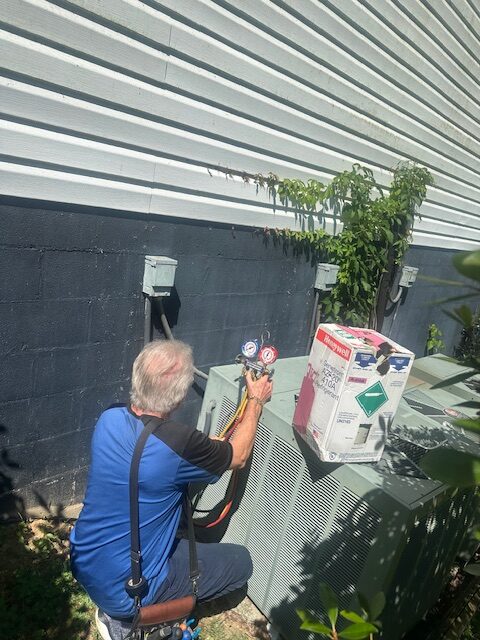
How Emergency Mode Heats Your Home Without the Compressor
Inside the air handler of most East Tennessee heat pump systems sits a heat kit, a set of electric resistance coils rated somewhere between 5 and 20 kilowatts depending on the size of the home and the design of the system. Those coils work the same way a toaster or a hair dryer works, converting electricity directly into heat as air passes across them. When emergency mode is active, the thermostat sends power through the E terminal, which energizes those strips and simultaneously keeps the compressor contactor from closing. The blower runs, air passes over the hot elements, and warm air moves through your ductwork. There is no refrigerant cycle involved at all during this operation. That simplicity is exactly why emergency mode exists, because resistance heat keeps working even when the outdoor unit is completely dead.
Dual fuel systems, which pair a heat pump with a gas or propane furnace, handle emergency mode differently but follow the same logic. Selecting emergency heat on a dual fuel setup shuts down the compressor and hands the entire heating load to the furnace burners. Homeowners with propane in rural Meigs and Rhea counties often find this arrangement more forgiving on the electric bill, though propane costs bring their own concerns during a long cold stretch. The furnace still needs proper venting, a clean flame sensor, and adequate gas pressure to carry that load safely for an extended period. Running a backup furnace as the primary heat source for weeks puts wear on components that were sized for occasional duty. A technician should verify the changeover settings and the furnace condition before that arrangement becomes your winter routine.
The blower plays a critical role in emergency operation, and airflow problems become dangerous in this mode. Electric heat strips generate a great deal of concentrated heat in a small space, and they depend on constant airflow to carry that heat away into the duct system. A clogged filter, a collapsed flex duct, or a failing blower motor allows heat to build inside the cabinet, which trips the high limit switch and cycles the strips off and on repeatedly. You may notice the house never quite reaches the setpoint, or you may smell a faint hot dust odor near the vents. Repeated limit trips shorten the life of the heat kit and the sequencers that control it. Changing your filter on a strict monthly schedule during heating season protects the entire system and keeps emergency heat working the way it was designed to work.
What Emergency Mode Costs You Every Hour It Runs
The financial difference between normal heat pump operation and emergency mode is not small, and it surprises nearly everyone who sees it on a bill for the first time. A heat pump moves heat rather than creating it, which allows it to deliver two to four units of heat energy for every unit of electricity it consumes at moderate outdoor temperatures. Electric resistance heat delivers exactly one unit of heat for every unit of electricity, with no multiplier at all. That means running emergency heat typically costs somewhere between two and three times as much as running the heat pump normally, and the gap widens on mild days when the heat pump would be operating at peak efficiency. A 10 kilowatt heat kit running steadily pulls a considerable load, and a 20 kilowatt kit pulls roughly double that. Over a full billing cycle, the difference frequently amounts to hundreds of dollars in a typical Tennessee home.
Many homeowners discover the problem in reverse, meaning the bill arrives first and the investigation follows. A power bill that doubles or triples without a matching change in weather is one of the clearest signs that a system has been running on backup heat. Comparing the current month to the same month in the previous year gives you a fair reference point, since weather patterns and rate structures shift year to year. If the jump is dramatic, walk to the thermostat and look for the EM Heat indicator or an AUX light that never seems to shut off. That small glowing symbol explains the entire bill in most cases. Catching it in November instead of February keeps the damage to one billing cycle rather than four.
There is also a hidden cost that shows up later in the form of equipment wear. Heat strips and their sequencers, contactors, and limit switches are built for supplemental duty measured in hours rather than months, and running them continuously accelerates failure of those components. Meanwhile, a compressor that sits idle all winter because of an unrepaired fault often develops additional problems from refrigerant migration and oil settling. The small failure that pushed the system into emergency mode grows into a larger one while you wait. Repairing the original fault promptly protects both halves of the system. Regular heat pump maintenance catches the early warning signs long before they force your system onto backup heat at all.
Common Reasons a Heat Pump Runs in Emergency Mode
When a heat pump enters emergency mode without anyone touching the thermostat, the cause traces back to one of three general areas: the refrigerant circuit, the outdoor unit and its defrost controls, or the thermostat and its wiring. Each area produces its own set of symptoms, and a trained technician narrows the field quickly using gauges, a meter, and the system’s own diagnostic codes. Homeowners can often gather useful clues before the truck arrives simply by observing when the problem occurs and what the outdoor unit is doing. Pay attention to whether the fan spins, whether the coil is covered in ice, and what temperature the air feels like at the closest register. Those three observations point a technician toward the right circuit faster than almost anything else. What follows are the failures we find most often across Kingston, Loudon, Lenoir City, and the surrounding communities.
Refrigerant and Compressor Faults That Trigger Emergency Mode
Low refrigerant charge stands as one of the most frequent reasons a heat pump loses its ability to heat and hands the job over to backup heat. A heat pump is a sealed system, so refrigerant does not get consumed the way fuel does, and any loss means a leak exists somewhere in the coils, the line set, a service valve, or a brazed joint. As charge drops, suction pressure falls, heating capacity collapses, and the system struggles to satisfy the thermostat even on mild days. The thermostat responds by calling for more auxiliary heat, and eventually a low pressure switch opens and locks the compressor out entirely. At that point the only heat left is the strips, which is functionally emergency operation regardless of what mode you selected. Simply adding refrigerant without finding the leak wastes money and releases more refrigerant into the atmosphere, so proper repair always begins with a leak search using electronic detection or nitrogen pressure testing.
The reversing valve is a component unique to heat pumps, and its failure produces one of the more confusing symptoms in the trade. That valve redirects refrigerant flow to determine whether your system heats or cools, and it is controlled by a small solenoid coil energized by the O terminal on your thermostat. When the solenoid coil burns out or the valve slides partway and sticks in the middle, the system may blow cool air during a heat call or fail to switch out of defrost properly. Homeowners sometimes describe it as the air conditioner running in December. A stuck valve also bleeds refrigerant internally between the high and low sides, which kills capacity and leaves the strips carrying the full load. Testing involves checking the solenoid for continuity, verifying voltage at the coil, and reading line temperatures across the valve body to confirm internal bypass.
Compressor failures represent the most serious category, and they show up in several forms. A failed run capacitor prevents the compressor from starting, producing a humming sound followed by a click as the internal overload opens. A shorted or grounded compressor winding trips the breaker outright. A locked rotor condition means the internal components have seized, which usually ends the useful life of the unit. In every one of these cases the thermostat sees no heat coming from the outdoor unit and shifts the entire load to backup, so the house stays warm while the real problem sits outside doing nothing. Age matters here, because a compressor failure on a system past fifteen years often makes replacement the better financial decision. A technician can measure winding resistance, check amperage draw against the nameplate rating, and give you a clear picture of what you are dealing with before you commit to anything.

Defrost and Outdoor Unit Problems That Force Emergency Mode
Every heat pump builds frost on the outdoor coil during heating operation, and that is completely normal in East Tennessee’s damp winter air. The outdoor coil operates below the surrounding air temperature in heating mode, so moisture in the air condenses on the fins and freezes. To clear it, the system runs a defrost cycle that reverses the refrigerant flow temporarily, shuts off the outdoor fan, and energizes the backup heat to keep the supply air from turning cold. You will see steam rolling off the unit, hear a whoosh as the reversing valve shifts, and notice the AUX light come on for a few minutes. A healthy defrost cycle lasts somewhere between five and twelve minutes and ends on its own. Trouble begins when defrost stops working or runs far more often than it should.
A failed defrost board or a bad defrost sensor leaves ice on the coil with no way to remove it. Ice accumulates layer by layer until the coil becomes a solid block, airflow across the fins stops completely, and the system loses all heating capacity. From the thermostat’s perspective the heat pump has simply quit, so backup heat takes over and stays on. Homeowners often walk outside and find the unit encased in ice with the fan blades frozen in place. Other causes include a failing outdoor fan motor, a restricted coil packed with leaves and grass clippings, low charge, or a drainage problem that lets runoff refreeze around the base pan. Never chip ice off with a tool, since the aluminum fins and copper tubing damage easily and a punctured coil turns a moderate repair into a major one.
The electrical components in the outdoor unit fail in ordinary ways that produce the same result. A pitted contactor may refuse to pull in, leaving the compressor and fan dead while the indoor unit runs normally. A weak dual run capacitor allows the fan to spin but not the compressor, or the reverse. Rodents chewing low voltage wiring in the whip is a common problem on rural properties around Ten Mile and Decatur, and a single broken conductor takes the outdoor unit offline. Tripped breakers, blown fuses in the disconnect, and corroded terminals all belong on the same list. Each of these leaves your home running on backup heat until someone traces the circuit and makes the repair, and most of them are inexpensive fixes when caught early.
Thermostat Settings and Wiring That Lock a Heat Pump in Emergency Mode
The simplest explanation is often the correct one, and a thermostat left on emergency heat accounts for a large share of the calls we take. Someone flips the switch during a hard freeze in January, the house warms up, and nobody ever switches it back. Months pass, bills climb, and the heat pump sits outside untouched. Take a moment to verify your thermostat is set to Heat or Auto rather than Em Heat, and confirm the fan is set to Auto rather than On. On older mercury and mechanical thermostats the emergency setting is a physical slider that is easy to bump. Checking this costs nothing and resolves the issue more often than most homeowners would guess.
Thermostat configuration errors cause the same problem in a less obvious way. A thermostat installed without setting the equipment type to heat pump will treat the O or B terminal incorrectly, which can leave the reversing valve energized or unenergized at exactly the wrong time. Balance point settings and outdoor temperature lockouts control when auxiliary heat is permitted to run, and a lockout configured at 50 degrees instead of 35 degrees invites the strips on far too early. Some thermostats include a droop setting that determines how far the room temperature must fall below the setpoint before backup heat engages, and an aggressive setting brings in strips during every recovery. Large setback schedules compound the issue, since a heat pump recovering from a six degree setback almost always pulls in auxiliary heat to catch up. Setting back only two or three degrees, or leaving the temperature steady, keeps a heat pump in its efficient range.
Wiring faults between the thermostat and the equipment create failures that look mechanical but are not. The E terminal energizes emergency heat, the W terminals control auxiliary stages, and Y controls the compressor contactor, so a crossed or shorted conductor at either end can force backup heat on continuously. Loose terminal screws, wire nuts that were never tightened in the air handler, and damaged thermostat cable inside a wall all produce intermittent behavior that comes and goes with temperature and vibration. Corrosion at the outdoor whip connection is common in our humid climate. A technician verifies each conductor end to end, confirms 24 volt control signals with a meter, and checks the equipment configuration against the manufacturer’s installation instructions. If your heat pump has quit and your home is cold right now, our 24/7 emergency HVAC service is available any hour of the day or night.
Why You Need Heat Pump Emergency Mode Repairs Before Winter Arrives
Every fall in the Tennessee Valley follows a familiar pattern, with warm afternoons giving way to the first hard freeze somewhere between late October and Thanksgiving. Heat pumps that sat idle through the summer heating season reveal their problems the moment that first real cold call comes through. Scheduling service now, while the weather still cooperates, means you get a full diagnosis without shivering through a night on backup heat. It also means parts are available and schedules are open, which is rarely true during the January rush. Affordable AC & Service has worked on heat pumps across Meigs, Roane, Loudon, Rhea, and Monroe counties for more than 35 years, and we know exactly what these systems do in this climate. Getting your equipment checked before the cold hits is the least expensive move you can make all season.
Schedule a Heat Pump Emergency Mode Inspection Early in the Season
An early season inspection covers everything that determines whether your heat pump carries the winter load or hands it to the strips. We check refrigerant charge against manufacturer specifications using superheat and subcooling measurements rather than guesswork, since a heat pump running even slightly low loses meaningful capacity in cold weather. We test the reversing valve, confirm the defrost board initiates and terminates correctly, and measure amperage on the compressor and fan motors. Electrical connections get tightened, capacitors get tested against their rated values, and the outdoor coil gets cleaned so air moves freely across the fins. Small corrections made in September and October prevent the failures that show up in December.
Indoor components receive the same attention during a heating season inspection. We verify airflow across the heat kit, confirm each strip stage energizes properly, and check the sequencers and limit switches that protect the equipment. Blower amp draw, filter condition, and duct static pressure all factor into how well the system performs and how hard it has to work. Thermostat configuration gets reviewed line by line, including balance points, staging, and lockout temperatures, because those settings control your operating cost more directly than almost anything else. Homeowners are often surprised how much a proper thermostat setup changes their bill. We explain every adjustment we make so you understand your system.
Timing matters more than most people realize when it comes to heating repairs. Parts distributors carry deeper inventory in early fall, which shortens the wait when a compressor, board, or motor needs replacing. Our schedule allows more flexibility before the first freeze fills the calendar with no heat calls. Repairs made in mild weather also let a technician run the system through complete cycles under controlled conditions rather than working in the dark during a storm. If replacement turns out to be the smarter choice for your home, you have time to compare options and review our heat pump installation service without pressure.

Emergency Mode Repairs and Around the Clock Service in East Tennessee
Heat pumps do not choose convenient hours to fail, and a system that drops into emergency mode at ten at night on a Saturday still needs attention. We answer emergency calls 24 hours a day, seven days a week, across our full service area including Kingston, Rockwood, Harriman, Spring City, Dayton, Decatur, Sweetwater, Athens, Loudon, Lenoir City, Farragut, Tellico Village, and Crossville. Our trucks carry the parts that fail most often, which lets us complete a large share of repairs on the first visit. Capacitors, contactors, defrost boards, sensors, and control transformers stay stocked year round. Getting your compressor running again the same night keeps your bill down and your family comfortable.
Running on emergency heat overnight is acceptable as a short term measure, and we would rather you stay warm than sit in a cold house waiting for morning. What matters is not letting that temporary arrangement become permanent. Backup heat keeps a house livable, but it does so at two to three times the cost, and every day adds to the total. Some homeowners run for an entire winter without realizing what happened, then face a spring bill that could have paid for the repair several times over. One service call at the right moment settles the entire issue.
Our diagnostic process is straightforward and honest, which is exactly how it should be. A technician tests the system, identifies the failed component, explains the finding, and quotes the repair before doing the work. We do not sell parts your system does not need, and we do not push replacement on equipment that has good years left in it. If the compressor has failed on a twenty year old unit, we will tell you plainly that replacement makes better financial sense and show you the numbers behind that opinion. You always make the final call with complete information in front of you.
Why Choose Affordable AC & Service for Heat Pump Emergency Mode Repairs
Affordable AC & Service has served Tennessee homeowners for more than 35 years, and we were recognized as the number one HVAC contractor in Meigs County for 2025. That record comes from doing careful work and standing behind it rather than chasing volume. Our technicians train specifically on heat pump controls, defrost logic, and refrigerant circuits, which is a different skill set than gas furnace work. Heat pumps carry more moving parts and more control complexity, so experience shows up quickly in the quality of a diagnosis. Homeowners across the Tennessee Valley call us because we get the answer right the first time.
We back our work with warranty coverage that goes well beyond what most contractors offer in this region. Every repair carries a five year labor warranty, and new system installations carry a fifteen year labor warranty. That commitment reflects real confidence in how we install and service equipment. Estimates are free on all services, and financing options are available for homeowners facing an unexpected replacement. You will never see a surprise charge appear after the work is finished.
Reaching us is simple, and we answer the phone at any hour. Call (423) 800-2029 or send a message to info@affordableacservice.com, and our office at 158 Hickory Ln in Ten Mile will get a technician headed your way. Emergency service runs around the clock, every day of the year, including holidays and weekends. If your thermostat is showing EM Heat right now, or your power bill jumped without explanation, do not wait for the next cold front to make the decision for you. One phone call gets your heat pump back to efficient operation before winter takes hold.